
GRINDING AND MILLING SYSTEMS
Turn difficult materials into the particle size your process requires.
Glen Mills helps laboratories, engineers, and manufacturers select equipment for crushing, dry grinding, wet milling, fine grinding, ultrafine milling, cryogenic processing, and analytical sample preparation—from a few grams through production-scale throughput.
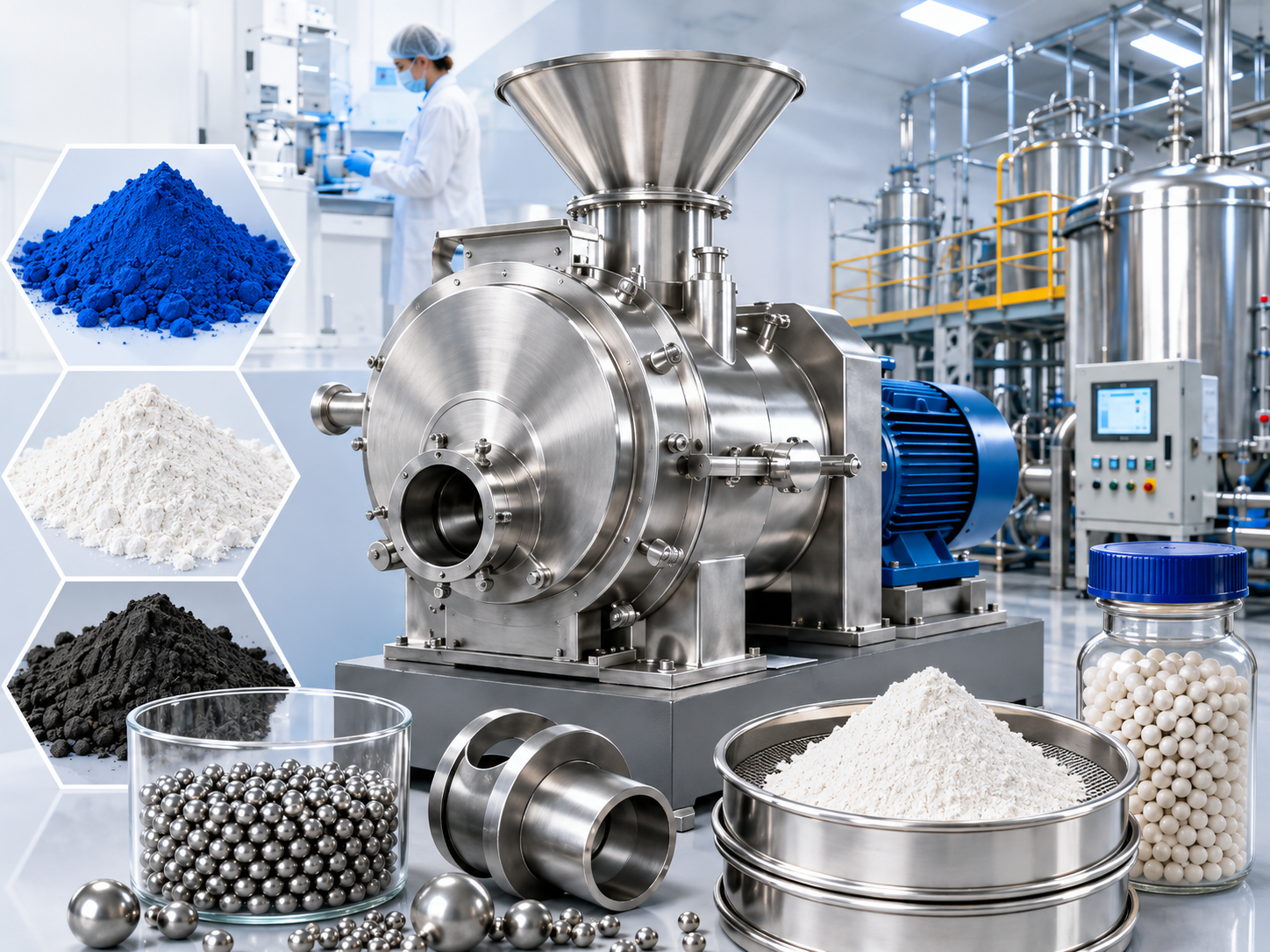
START WITH THE RESULT
What grinding outcome do you need?
Feed size, material behavior, final fineness, batch size, heat sensitivity, and contamination limits determine the best milling principal.
Not sure? Get a recommendation >

Coarse Crushing & Pre-Crushing
Reduce large, hard, brittle, or tough feed material before fine grinding or analytical preparation.

Dry Grinding
Process dry materials through impact, cutting, friction, pressure, or attrition.

Wet Grinding & Dispersion
Create fine suspensions, reduce dust, manage heat, or process materials that benefit from liquid media.

Fine Grinding
Produce consistent powders for analysis, formulation, quality control, or downstream processing.

Ultrafine & Nano Grinding
Apply high-energy impact, particle collision, or media milling for micron and submicron targets.

Cryogenic Milling
Embrittle heat-sensitive, elastic, oily, or difficult materials while limiting thermal damage.

Analytical Sample Preparation
Prepare representative samples for XRF, XRD, NIR, elemental analysis, and quality control.

Production Size Reduction
Scale a validated method to larger batches, continuous operation, and integrated collection.
APPLICATION FIRST GUIDANCE
A better process starts with the material.
Instead of forcing your material into one machine, we evaluate the material, target the result, batch size, contamination limits, and scale-up requirements.
Five questions that define the process
These inputs control the shortlist and prevent over- or under-specifying equipment.
01
What is the material?
02
What are the starting and target sizes?
03
What must be protected?
04
How much must be processed?
05
What are the operating constraints?
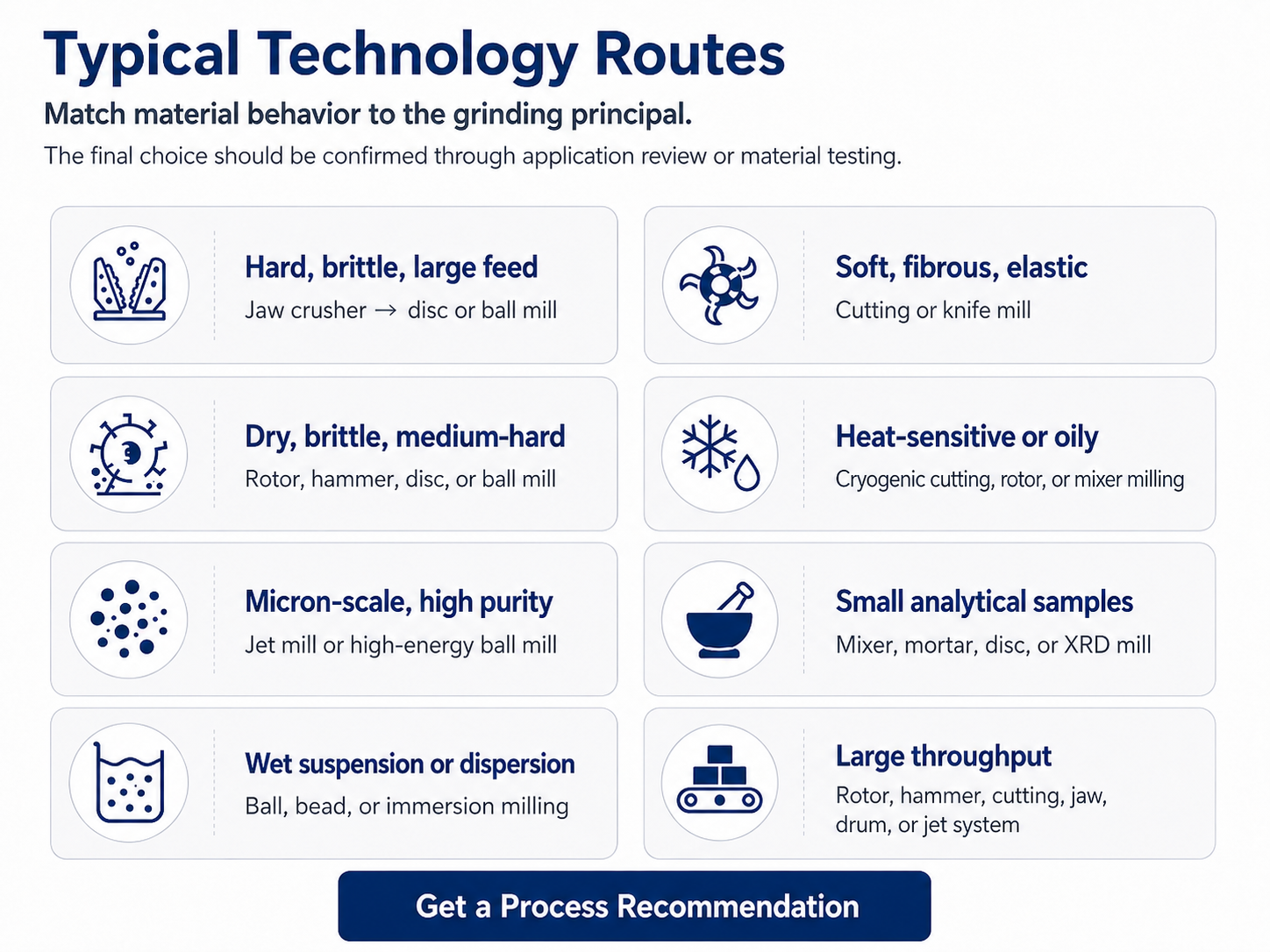
BROWSE BY EQUIPMENT FAMILY
Grinding technologies for every material class
Each family uses a different combination of compression, cutting, impact, friction, shear, or particle collision.
Jaw Crushers
Rapid pre-crushing of medium-hard, hard, brittle, and tough materials.
| Large Feed | Pre-Crushing |
Rotor & Hammer Mills
Flexible impact grinding for soft to medium-hard, brittle, fibrous, and bulk materials.
| Impact | High Throughput |
Knife Mills
Fast size reduction and homogenization of food, feed, biological, and soft-to-tough samples.
| Food & Feed | Homogenizing |
Jet Mills
Compressed air or inert gas drives particle-on-particle collisions for fine, narrow distribution grinding.
| Micron | Sub-Micron | High Purity |
Planetary Ball Mills
High centrifugal energy for dry, wet, colloidal, mechanical alloying, and nano-scale applications.
| High Energy | Nano Grinding |
Mixer Mills
Rapid dry, wet, and cryogenic grinding of small samples using oscillating jars and grinding balls.
| Small Samples | Cryogenic |
Mortar Grinders
Gentle pressure and friction grinding for preparation, mixing, and homogenization.
| Gentle | Pastelike Samples |
Drum & Ball Mills
Batch grinding and mixing using rotating drums with selected grinding media.
| Batch | Wet or Dry |
Specialized Sample Prep Mills
Purpose-built systems for XRD, NIR, biological samples, and analytical workflows.
| XRD | NIR |
Cutting Mills
Controlled cutting of soft, tough, elastic, fibrous, and heterogeneous materials.
| Fibrous | Tough |
Vibratory Disc Mills
Fast, loss-minimized grinding of brittle and fibrous materials to analytical fineness.
| Analytical | Reproducible |
PROCESSING MODES
Choose the operating environment that protects your materials.
The same target size can require a different process depending on temperature sensitivity, dust, oxidation, purity, or suspension requirements.
Dry Grinding
Direct powder production for stable, free-flowing, or suitable conditioned materials.
- Batch or continuous processing
- Multiple collection options
- Broad Equipment Selection
Wet Grinding
Use liquid to control dust and heat, improve dispersion, or achieve very fine particles.
- Suspensions and slurries
- Fine and colloidal grinding
- Reduced airborne powder
Cryogenic Grinding
Cool the sample to embrittle difficult materials and limit heat-related changes.
- Elastic and oily materials
- Heat-sensitive products
- Volitile samples

Inert Gas Processing
Use a suitable gas where oxidation, combustion risk, or reactivity must be managed.
- Oxidation-sensitive powders
- Jet milling options
- Closed systems

Sanitary & GMP Configurations
Support cleaning and product-contact requirements with stainless construction.
- Pharmaceutical and food use
- Rapid disassembly
- Contact material choices
Abrasion-Resistant Processing
Manage wear and contamination through liners, media, and contact-part selection.
- Replaceable wear components
- Speciality liners
- Media optimization
LAB, PILOT & PRODUCTION
Develop a process that can move beyond the first sample.
Establish a practical form of feasibility testing to pilot validation and manufacturing throughput.
Lab Scale
Research, sample preparation, formulation, and feasibility studies using grams to small batches.
- Broad Flexibility
- Fast Cleanup
- Parameter Development
Pilot Scale
Generate scale-up data, optimize conditions, and produce larger representative samples.
- Process Validation
- Pre-Production Batches
- Feeding and Collection
Production Scale
Configure throughput, controls, wear, protection, and collection for manufacturing.
- Batch or Continuous
- Integrated Systems
- Specialized Options
MATERIALS & INDUSTRIES
Grinding solutions for difficult and valuable materials.
Material properties drive the correct choice, but these are common application areas supported by Glen Mills equipment.
Pharmaceuticals
Battery Materials
Chemicals & Catalysts
Food, Feed & Grains
Polymers & Plastics
Ceramics & Minerals
Metals & Alloys
Biological Samples
Recycling & Waste
Glass & Construction
Agricultural Products
Research & Universities
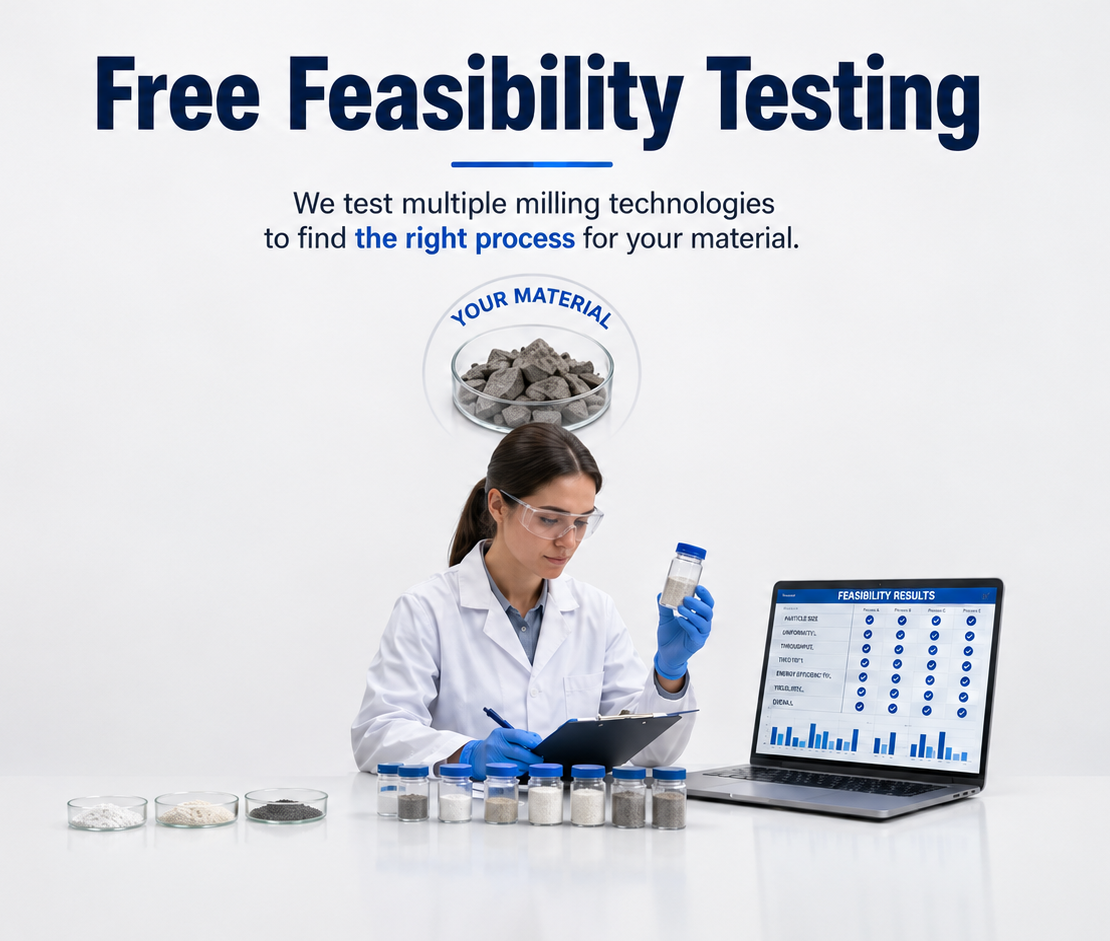
MATERIAL TESTING & PROCESS DEVELOPMENT
Do not select a mill from specifications alone.
Send your material and target result to Glen Mills. Testing can identify a suitable grinding principal, establish operating parameters, produce representative samples, and reduce selection risk.
 Feasibility Testing
Determine whether the target is practical.
Equipment Comparison
Compare promising technologies.
Sample Production
Receive material for downstream evaluation.
Scale-Up Guidance
Connect test results to larger needs.
FLEXIBLE WAYS TO PROCEED
Test, rent, prototype, outsource, or purchase.
The correct next step depends on technical confidence, timing, capital plans, and required quantity

Equipment Rentals
Evaluate equipment in your facility or meet a short-term need before purchasing.
Prototyping & Samples
Have material processed and returned with equipment and process information.
Contract Grinding
Outsource processing when demand does not justify internal equipment ownership.

Grinding Media Selection
Select material, density, diameter, hardness, and finish for performance and purity.
WHY GLEN MILLS
Choose the process, not just the mill.
Connect application requirements to equipment, testing, media, accessories, collection, and scale-up support.
01 – APPLICATION FIRST
Recommendations based on the material
Hardness, toughness, elasticity, temperature, wear, and purity guide selection.
02 – MULTIPLE TECHNOLOGIES
Compare different grinding principles
Evaluate crushing, impact, cutting, friction, pressure, and collision.
03 – TEST BEFORE PURCHASE
Validate results with your material
Testing provides stronger evidence than brochure specifications alone.
04 – COMPLETE SYSTEM
Go beyond the mill chamber
Address feeding, cooling, collection, filtration, containment, and cleaning.
05 – SCALE UP SUPPORT
Plan from laboratory to production
Identify what must change as capacity and process complexity increase.
06 – FLEXIBLE ENGAGEMENT
Purchase is not the only option
Use rentals, prototyping, samples, and contract grinding when appropriate.
GET MY GRINDING RECOMMENDATION
Tell us about your material and target result.
An application specialist can narrow the equipment family, identify missing process information, and recommend testing or a next step.
- Material and current form
- Starting and target particle size
- Batch size or throughput
- Temperature, purity, dust, and cleaning constraints