
PLANETARY MIXING & DEGASSING
Mix, Disperse and Degas Viscous Fluids Without Conventional Blades
Produce uniform, air-free formulations in sealed containers using simultaneous revolution and rotation. Process adhesives, pastes, slurries, inks, coatings, battery materials, silicones, and other difficult formulations from laboratory development through production.
Already know your batch size? Request a Quote >
Mix | Disperse | Degas | Defoam | Prevent Separation | Process Directly in the Container
START WITH THE FORMULATION PROBLEM
What is keeping your process from being repeatable?
Select the challenge that best describes your material. Glen Mills will help match the formulation, container, batch size and degassing requirement to the right mixing & degas solution.
Not sure? Get a recommendation >

Entrapped Air and Microbubbles
Remove bubbles that reduce conductivity, optical clarity, dispense accuracy, strength, or surface quality.

Incomplete Powder Wet-Out
Rapidly incorporate powders into resins, binders and liquids while reducing unmixed agglomerates.

Inconsistent Formulations
Use programmable operating conditions to improve repeatability between operators and batches.

Heat-Sensitive Materials
Use controlled speed patterns and lower-speed operating modes to limit unnecessary thermal rise.

Cross Contamination and Cleanup
Mix in removable or disposable containers instead of cleaning conventional blades and mixing vessels.

Scale-Up Uncertainty
Develop operating conditions at small scale and move toward larger dual-cup and production systems.
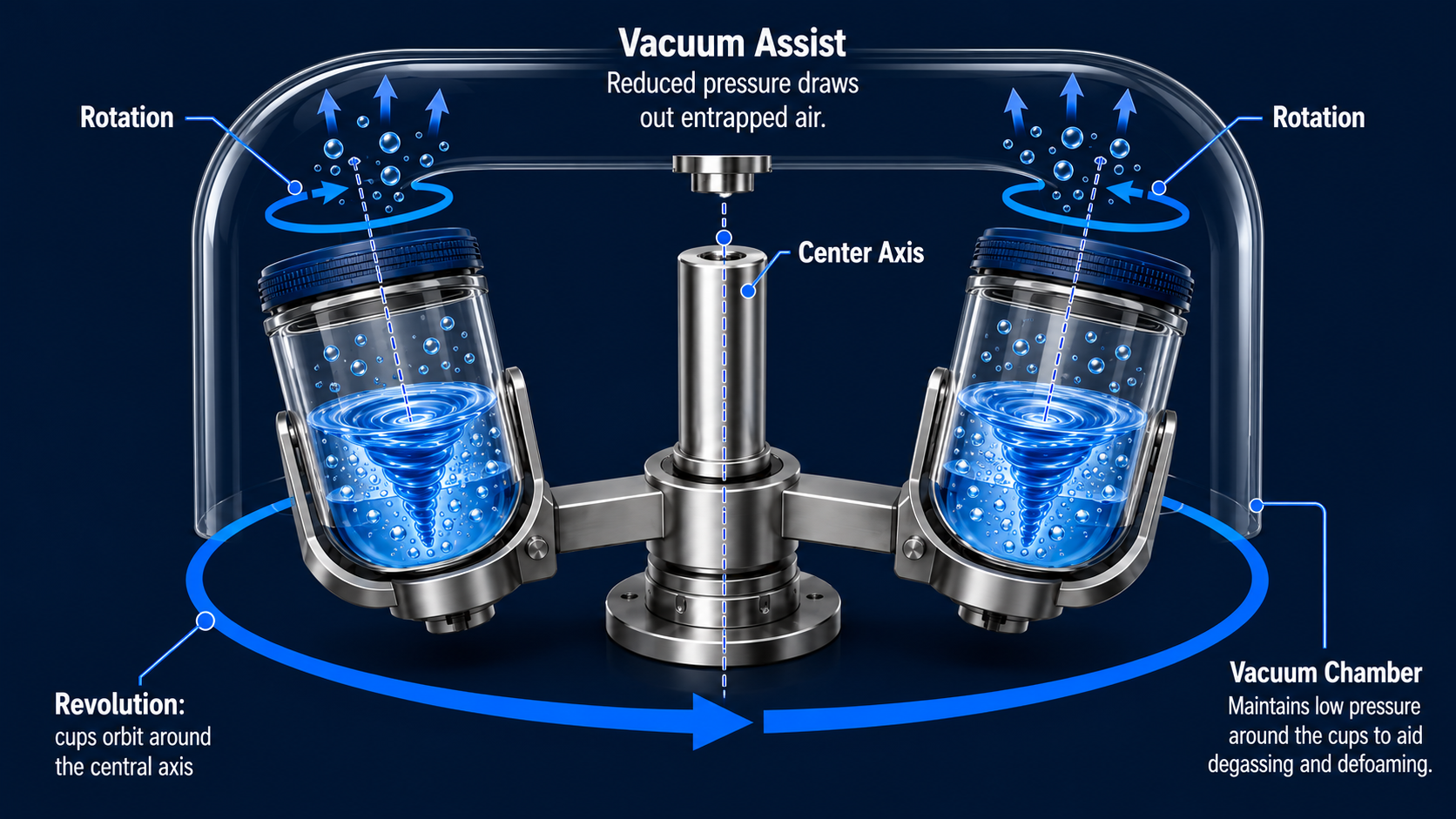
HOW PLANETARY CENTRIFUGAL MIXING WORKS
Two synchronized motions create intense internal material flow.
The container revolves around the machine’s central axis while rotating around its own axis. The resulting acceleration folds, shears and circulates material throughout the container. A degassing cycle uses a different revolution-to-rotation relationship to move trapped air out of the formulation.
Non-contact processing
No internal blades or agitators contacting the formulation..
Mix and degas in one system
Use sequential programmable steps instead of transferring material between machines.
Closed-container operation
Reduce exposure, material loss and cleanup while processing directly in compatible vessels.
CHOOSE BY SCALE AND PROCESS REQUIREMENT
A mixer for every stage of development.
The most important selection factors are usable container volume, material weight, required degassing level, heat sensitivity, container format and production throughput.
300 ML – SINGLE CUP
Compact R&D Mixing
Ideal for formulation screening, laboratory development, and small-volume mixing and degassing.
300-400 ML – DUAL CUP
Advanced Development
Higher capacity, two-cup balancing and independently controlled revolution and rotation options.
VACUUM-ENHANCED
Fine Bubble Removal
For electronic, optical, syringe and other applications where residual microbubbles are unacceptable.
1.1-10.0 L PER CUP
Pilot & Production
Scale formulations into medium and large dual-cup systems while maintaining the same core mixing principle.
INDUSTRIAL APPLICATIONS
Mix difficult powders across research and manufacturing.
Recommendations consider powder behavior, blend ratio, target uniformity, sensitivity, contamination risk, batch size, and downstream processing..
Battery Slurries
Adhesives & Sealants
Electronic Materials
Inks & Coatings
Silicones
Cosmetics
Dental Materials
Resins & Composites
Pharmaceutical Formulations
Optical Materials
Thermal Compounds
Ceramic Slurries
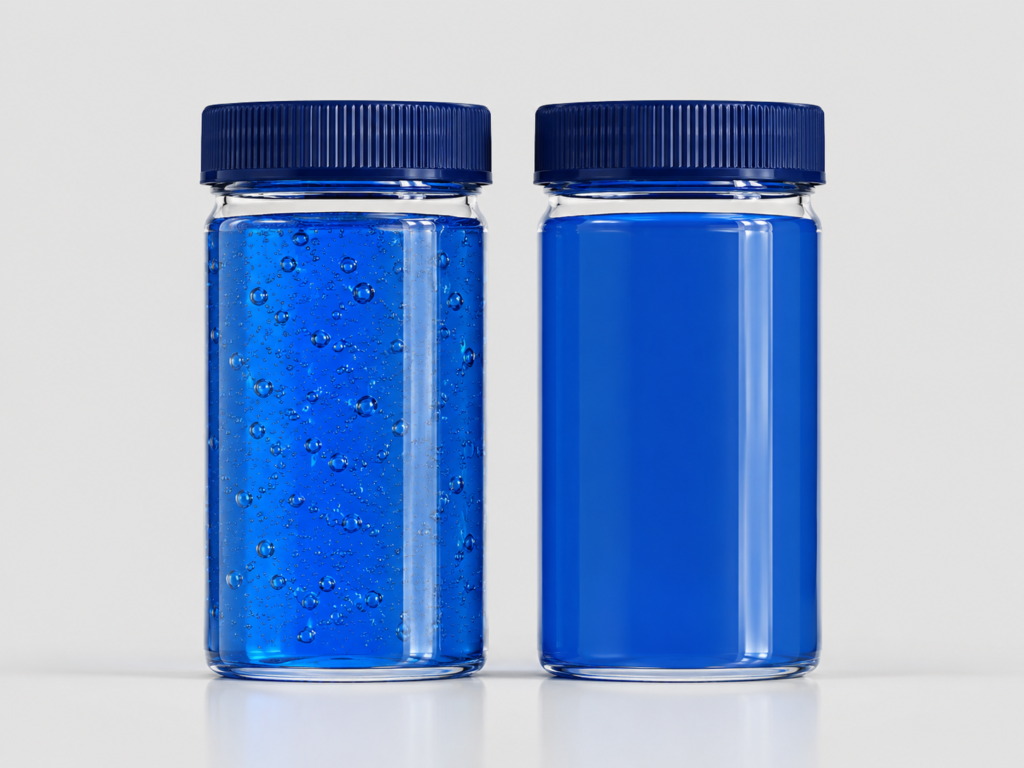
PROCESS BENEFITS
Improve formulation quality while simplifying the workflow.
Uniform Dispersion
Distribute powders and additives throughout high-viscosity materials.
Faster Development
Mix and degas in short programmable cycles.
Repeatable Recipes
Store operating conditions for consistent batch processing.
Reduced Air Content
Improve appearance, conductivity, strength and dispensing consistency.
Less Material Loss
Process directly in the selected container or syringe.
Flexible Containers
Use adapters for cups, syringes, cartridges and specialized formats.
REDUCE RISK BEFORE YOU BUY
Reduce risk before you select a mixer.

Material Testing
Send your material and target result for an initial processing evaluation.

Prototyping & Samples
We run your material and return representative samples with process information

Contract Mixing
Outsource blending when equipment ownership is not the right immediate step.

Equipment Rentals
Evaluate a mixer in your facility or meet a temporary development or production need.
FREE FEASIBILITY EVALUATION
Send us your material. See what the process can do.
Provide your formulation, batch size, current problem and target result. Glen Mills will help identify the right operating approach and equipment scale.
- Mixing and dispersion evaluation
- Standard or vacuum degassing assessment
- Container and adapter guidance
- Equipment and scale-up recommendation
Request an application review.
An application specialist will review the information and contact you about the next step.
TALK WITH A FLUID-MIXING SPECIALIST
Not sure which mixer or degassing method is right?
Start with the material, batch size, and result you need. We will help determine whether standard centrifugal degassing, vacuum processing or a specialized container system is the best path.