
PARTICLE CHARACTERIZATION SOLUTIONS
Particle Size & Shape Analysis
Measure particle size distributions, morphology, oversize fractions, nanoparticles, and process changes with optical analyzers selected for your material, sample state, measurement range, and quality goals.
START WITH THE MEASUREMENT GOAL
What do you need to know about your particles?
Different measurement principles reveal different information. Start with the decision your data must support—not the analyzer model.

Measure Particle Size Distribution
Determine percentiles, distribution width, multimodal populations, and batch-to-batch consistency for powders or suspensions.

Characterize Shape & Morphology
Quantify length, width, aspect ratio, roundness, circularity, convexity, symmetry, and other particle-specific descriptors.

Detect Oversize, Undersize or Defects
Identify small unwanted fractions, agglomerates, satellites, broken particles, or shape defects that averages can conceal.

Modernize or Replace Sieve Analysis
Increase throughput, reduce manual weighing and cleaning, and retain useful correlation with established sieve specifications.

Analyze Nanoparticles & Colloids
Measure hydrodynamic particle size in suspensions and evaluate concentration, molecular weight, or zeta potential where required.

Monitor the Production Process
Integrate continuous or at-line particle measurement to recognize process changes faster and support real-time quality decisions.
Analyzer Selection Assistant Select your sample condition and primary measurement goal. The result is a preliminary method recommendation—not a substitute for a sample evaluation. For dry powders and granules where both size and shape matter, dynamic image analysis provides direct measurement of individual particles and strong sensitivity to oversize fractions. This is a preliminary recommendation. Final method and instrument selection should be confirmed with a representative sample evaluation.Find a practical starting point.
Tell us about the sample.
Dynamic Image Analysis — CAMSIZER
MEASUREMENT TECHNOLOGIES
Choose the information—not just the range.
Direct versus indirect measurement, sample dispersion, throughput, shape requirements, and sensitivity to rare particles are as important as measuring range.
FAST, VERSATILE SIZING
Laser Diffraction
Calculates size distributions from light-scattering patterns produced by a dispersed sample.
- Broad dynamic range
- Wet and dry options
- Routine QC
- Rapid analysis
DIRECT SIZE + SHAPE
Dynamic Image Analysis
Records moving particles and evaluates individual images in real time.
- Size and morphology
- Strong oversize detection
- High throughput
- Dry, wet, online
HIGH-DETAIL MICROSCOPY
Static Image Analysis
Images stationary particles on a slide for detailed visual information.
- High-resolution images
- Fine-particle morphology
- Dry and wet samples
- Strong R&D fit
NANOPARTICLE ANALYSIS
Dynamic Light Scattering
Uses Brownian motion to determine hydrodynamic size in suspensions and emulsions.
- Nanometer capability
- Wide concentration range
- Small sample volumes
- Zeta options
METHOD COMPARISON
Which analysis method fits the application?
This framework is a starting point. Actual suitability depends on distribution, optical properties, dispersion behavior, volume, and reporting requirements.
| Method | Best Fit | Typical Information | Sample Modes | Portfolio Range |
|---|---|---|---|---|
| Laser Diffraction | Fast routine sizing across broad distributions | Volume-based size distribution | Dry and wet | 10 nm–4 mm |
| Dynamic Image Analysis | Size, shape, rare-particle detection, sieve correlation | Individual dimensions and morphology | Dry, wet, online | 0.9 µm–135 mm |
| Static Image Analysis | Fine particles requiring high-detail images | Individual-particle size and shape | Dry or wet slides | 0.5 µm–1.5 mm |
| Dynamic Light Scattering | Nanoparticles, colloids, emulsions | Hydrodynamic size; optional zeta, concentration, molecular weight | Liquid dispersions | 0.3 nm–10 µm |
ANALYZER PORTFOLIO
Match the analyzer to the sample and decision.
Use these model groups to narrow the field. Glen Mills can review your material and arrange testing before final selection.
0.1 – 4,000 µm
Microtrac SYNC
Combines tri-laser diffraction and dynamic image analysis in one workflow for particle size plus more than 30 morphological parameters.
- Wet & Dry
- ~30 sec
- QC + R&D
METHOD ADVANTAGE
One Sample, Complementary Data
Use diffraction for the distribution and imaging for morphology and better visibility of rare coarse or fine fractions.
- ISO 13320
- ISO 13322-2
- QC + R&D
VALIDATION READY
Routine Quality Control
Fast wet/dry module changes, reproducible methods, and available IQ/OQ documentation support regulated workflows.
- 21 CFR Part 11
- Method Storage
CAMSIZER Dynamic Image Analysis
Direct measurement of moving particles for detailed distributions, shape parameters, high counts, and strong oversize detection.
0.9 µm – 8 mm
CAMSIZER X2+
Versatile dry and wet analyzer for fine powders, granules, and suspensions with dual cameras and interchangeable dispersion modules.
- Dry & Wet
- 1-3 min
- Shape Analysis
160 µm – 135 mm
CAMSIZER XL
Characterizes large particles and bulk materials with customizable sample introduction and more than 40 parameters.
- Coarse Materials
- Non-Contact
- Large Samples
20 µm – 30 mm
CAMSIZER 3D
Tracks dry, free-flowing particles through multiple orientations to distinguish length, width, and thickness and improve defect analysis.
- Dry Bulk Solids
- 2-5 min
- 3D Tracking
30 µm – 30 mm
CAMSIZER ONLINE
Rugged online analysis for process integration, control-room use, automatic sample delivery, and continuous quality monitoring.
- Process Control
- Explosion Proof
- Self-Cleaning
30 µm – 5 mm
CAMSIZER S1
Streamlined dynamic image analyzer for routine dry-particle QC, basic shape definitions, and efficient sieve correlation.
- Dry QC
- 2-5 min
- Simple Operation
0.5 µm – 1.5 mm
CAMSIZER M1
Static image analysis for high-resolution size and shape characterization of fine particles prepared dry or wet on slides.
- Static Imaging
- Fine Particles
- R&D
NANOTRAC Dynamic Light Scattering
Nanoparticle sizing for suspensions and emulsions with flexible sample handling and optional zeta-potential characterization.
0.3 µm – 10 µm
NANOTRAC FLEX
External fixed probe enables dip-and-measure operation, in-situ monitoring, very small sample volumes, and flexible vessels.
- External Probe
- From 2 µL
- At-Line / In-Line
0.3 nm – 10 µm
NANOTRAC WAVE II / ZETA
Compact DLS analyzer with reusable cells for size, concentration, molecular weight, and optional high-concentration zeta measurements.
- Reusuable Cells
- Zeta Option
- Fixed Optics
SIZE + STABILITY
NANOTRAC DUO
Combines NANOTRAC FLEX with STABINO ZETA to correlate particle size and zeta potential within the same sample workflow.
- Particle Size
- Zeta Potential
- Titration
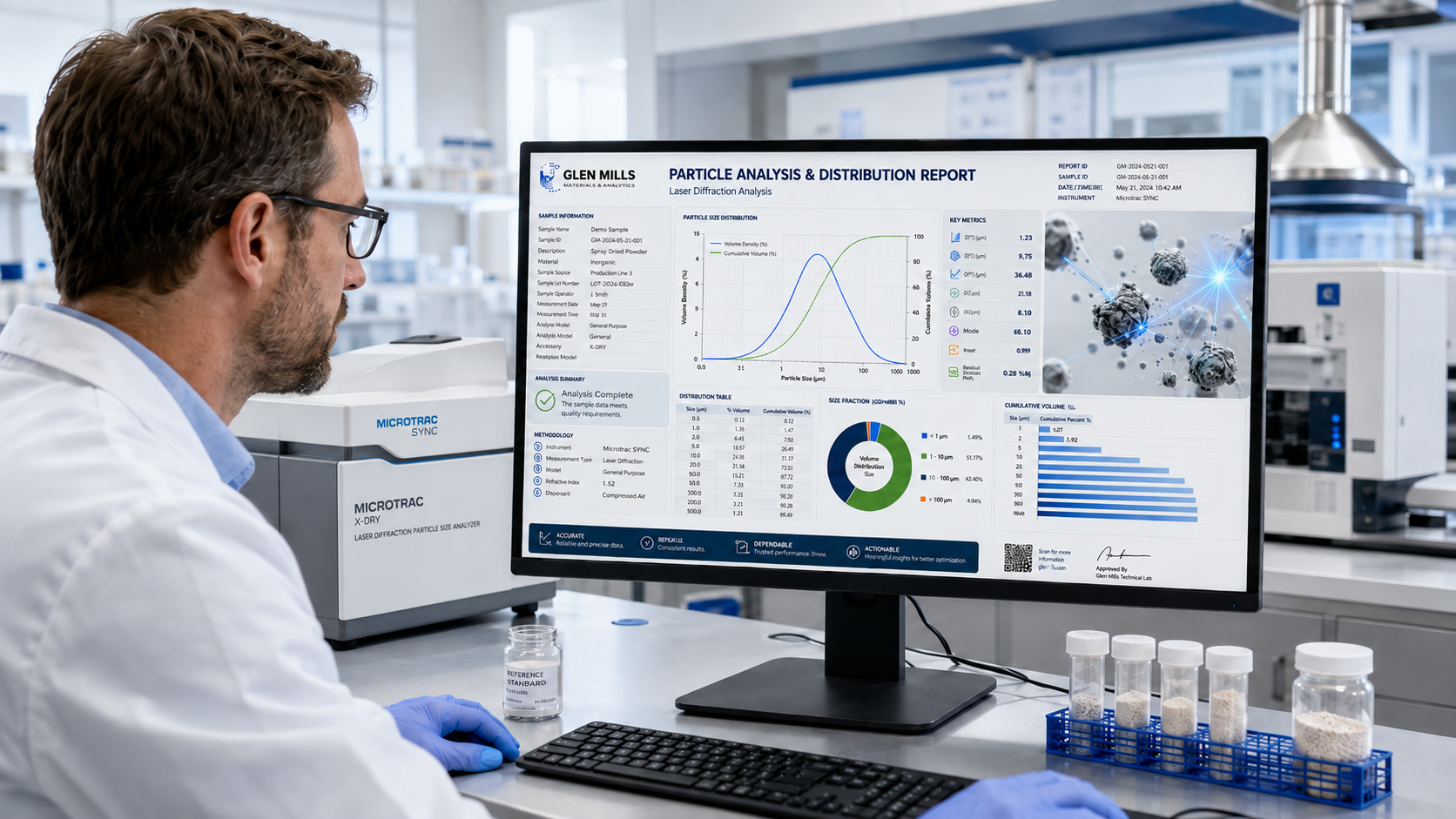
WHY MEASURE MORE THAN AVERAGE
Particle characteristics influence how materials process and perform.
A complete characterization can reveal changes in flow, packing, dissolution, reactivity, appearance, coating behavior, filtration, and final-product consistency.
Improve Process Control
Recognize shifts before off-spec batches
Evaluate Milling Results
Measure fines, coarse tails, and shape changes.
Detect Defects
Find agglomerates, satellites, and broken granules.
Compare Suppliers
Quantify differences hidden by one median.
Optimize Formulations
Connect particles to dispersion and behavior.
Document Quality
Standardize methods and traceable reports.
INDUSTRIES & SAMPLE TYPES
Particle data for development, quality, and production.
Microtrac analyzers are used wherever particle size, shape, or dispersion state affects performance.
Pharmaceuticals
Food & Ingredients
Polymers & Plastics
Battery Materials
Chemicals & Pigments
Coatings & Inks
Additive Manufacturing
Building Materials
Metal Powders
Ceramics & Abrasives
Geology & Mining
Research & Universities
APPLICATION TESTING
Measure your material before selecting the analyzer.
A sample evaluation helps confirm dispersion behavior, useful range, repeatability, reporting parameters, and the most appropriate technology.

Define the Goal
Tell us what decision the measurement must support.

Submit the Sample
Provide material, SDS, and relevant specifications.

Review the Data
Compare results and discuss the recommended approach.
Request a sample measurement.
Use application testing to reduce uncertainty before purchasing equipment or developing a QC method.
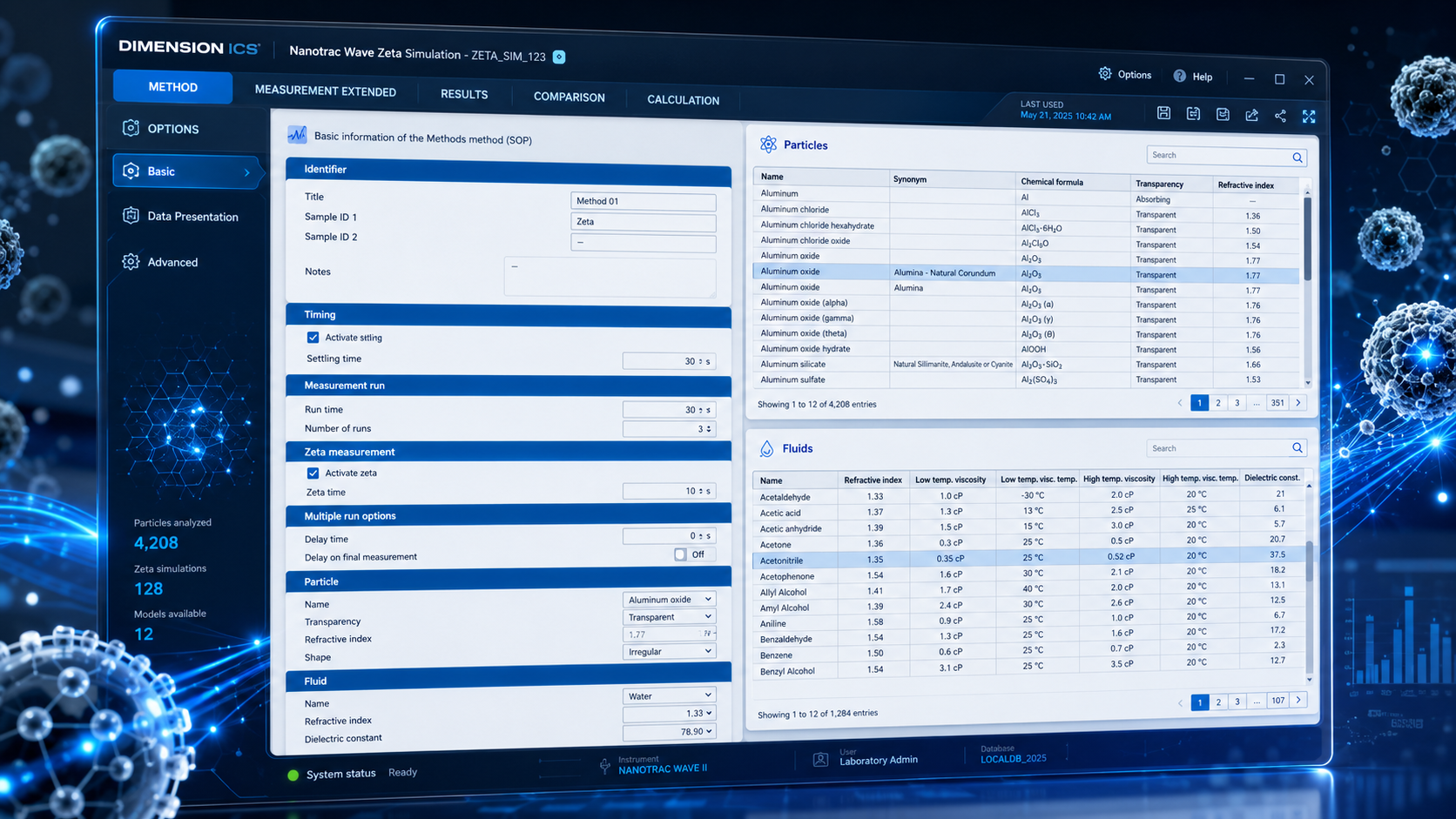
MEASUREMENT & EVALUATION SOFTWARE
Build methods, run measurements, and interpret results in one environment.
DIMENSIONS provides workspaces for method development, analyzer operation, result presentation, comparison, recalculation, reporting, and data management.
Particle image libraries
Flexible result comparison
Clear method setup
Live measurement control
Export and reporting
Regulated workflow options
TALK WITH A PARTICLE SPECIALIST
Find the analyzer that answers the right question.
Share your sample type, expected range, current method, and the information you need. Glen Mills will help narrow the technology and next step.
- Method and model selection
- Sample testing and data review
- Wet or dry dispersion guidance
- Quotation and configuration support
ALREADY KNOW THE MODEL?
Request pricing or technical information.
Tell us which Microtrac analyzer you are considering and any accessories, dispersion modules, validation documentation, or software options.