
LABORATORY & QUALITY CONTROL SIEVE SHAKERS
Reliable Particle Size Analysis from Fine Powders to Coarse Materials
Achive accurate, repeatable particle size determination, separation, and fractionation with vibratory, horizontal, tap, and air jet sieve shakers matched to your material and testing method.
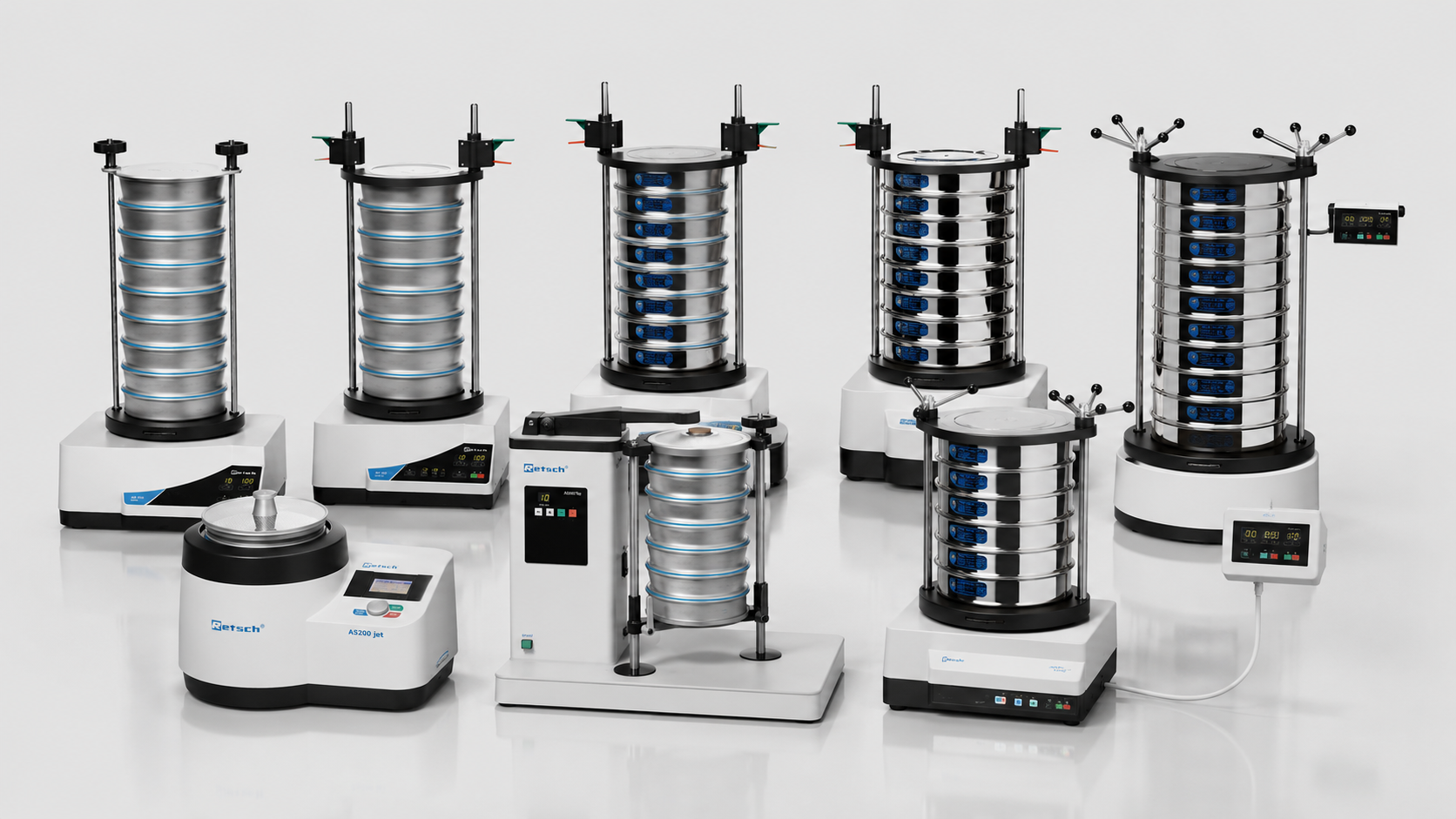

10 µm to 125 mm
Broad measuring range

Four Sieving Motions
Vibratory, horizontal, tap, air jet

Dry & Wet Sieving
Model and material dependent

Repeatable Results
Digital settings and documentation
START WITH YOUR TESTING GOAL
What do you need the sieve analysis to accomplish?
Start with the required result—not a model number. The sample, method, sieve diameter, and reporting requirements determine the right system.

Determine Particle Size Distribution
Measure the mass retained across defined fractions.


Meet a Testing Standard
Reproduce a controlled motion, time, amplitude, and procedure.

Separate or Recover Fractions
Generate clear coarse, intermediate, and fine fractions.
Choose a motion >

Develop a Sieving Method
Test the material and establish practical operating settings.
TYPICAL TECHNOLOGY ROUTES
Match material behavior to the sieving principal.
The final choice should be confirmed through application review or material testing, especially for cohesive powders, elongated particles, standards-sensitive methods, and large sample loads.
MOST VERSATILE
Vibratory Sieving
A controlled three-dimensional throwing motion repeatedly presents particles to the mesh openings.
- General laboratory and QC work
- Powders, granules, and coarse material
- Dry or wet sieving on selected models
View vibratory models >
SHAPE-SENSITIVE SAMPLES
Horizontal Sieving
A circular motion keeps particles on one plane and supports gentle, controlled classification.
- Elongated, flat, or needle-like particles
- Large sieve diameters
- Gentler sample movement
View horizontal models >
STANDARDS-SENSITIVE MOTION
Tap Sieving
Horizontal circular movement combined with vertical taps mechanizes traditional hand-sieving action.
- Methods that specify tapping
- Dense or difficult-to-orient particles
- Repeatable mechanical hand-sieving
View tap models >
FINE COHESIVE POWDERS
Air Jet Sieving
A rotating air jet disperses fine powder and continuously clears the sieve mesh during analysis.
- Fine or agglomerated powders
- Single-sieve analysis
- Advanced weighing and compliance options
View air jet models >
Analyzer Selection Assistant Select your sample condition and primary measurement goal. The result is a preliminary method recommendation—not a substitute for a sample evaluation. For dry powders and granules where both size and shape matter, dynamic image analysis provides direct measurement of individual particles and strong sensitivity to oversize fractions. This is a preliminary recommendation. Final method and instrument selection should be confirmed with a representative sample evaluation.Find a practical starting point.
Tell us about the sample.
Dynamic Image Analysis — CAMSIZER
WORKING PRINCIPAL
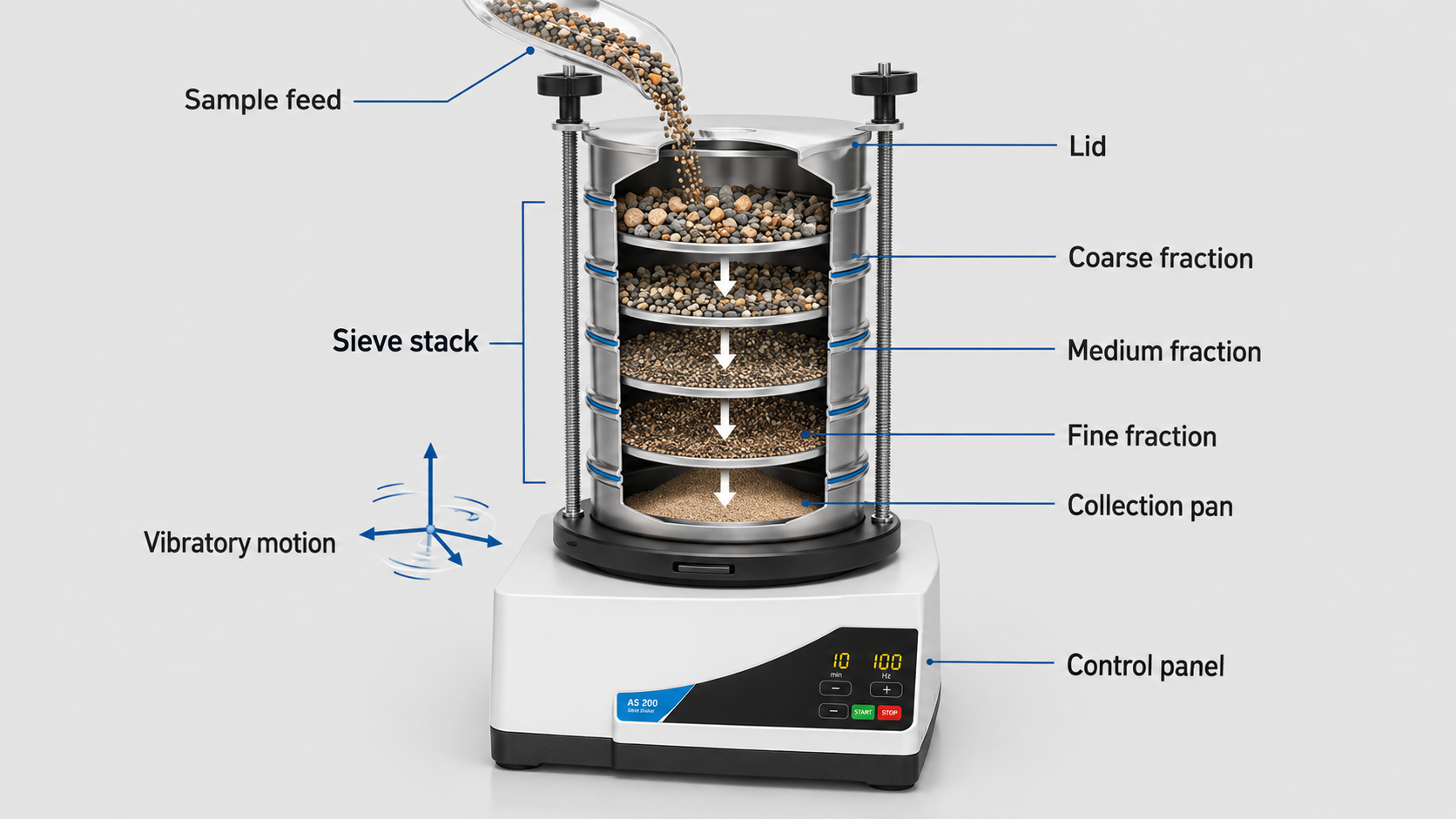
How sieve shakers separate a sample.
A stack of test sieves is arranged with the largest openings at the top and progressively finer mesh below. Controlled motion redistributes the sample so particles repeatedly encounter the openings.
Place a representative, properly prepared sample on the upper sieve.
Set time, amplitude, speed, or pressure according to the instrument and method.
Smaller particles pass through while larger particles remain on the appropriate sieve.
Calculate the mass retained on each sieve to determine the particle-size distribution.
SIEVE SHAKER MODELS
Compare the full equipment family.
Use these motion groups to narrow the field. Glen Mills can review your material and arrange testing before final selection.
VIBRATORY SIEVE SHAKER
AS 200 Basic
Straightforward digital operation for routine laboratory sieving.
Explore the AS 200 Basic>
VIBRATORY SIEVE SHAKER
AS 300 Control
Controlled vibratory sieving for larger sieve diameters and sample quantities.
Explore the AS 300 Control>
AIR JET SIEVING MACHINE
AS 200 Jet
Rapid, gentle analysis of fine powders that agglomerate or blind the mesh.
Explore the AS 200 Jet>
TAP SIEVE SHAKER
AS 200 Tap
Mechanizes hand sieving for methods requiring circular motion with taps.
Explore the AS 200 Tap >
VIBRATORY SIEVE SHAKER
AS 200 Digit cA
A versatile standard configuration with digital amplitude control.
Explore the AS 200 Digit cA>
VIBRATORY SIEVE SHAKER
AS 450 Basic
A cost-conscious route for large-diameter sieves and coarse samples.
Explore the AS 450 Basic>
ADVANCED AIR JET SYSTEMS
AS 200 Jet Pro / Pharma
Advanced automation, with a pharma configuration for controlled workflows.
Explore the AS 200 Jet Pro/Pharma >
VIBRATORY SIEVE SHAKER
AS 200 Control
Designed for tightly controlled, reproducible quality control procedures.
Explore the AS 200 Control>
VIBRATORY SIEVE SHAKER
AS 450 Control
High-performance 3D movement for demanding, large-capacity analysis.
Explore the AS 450 Control>
HORIZONTAL SIEVE SHAKER
AS 400 Control
For elongated, flat, or shape-sensitive particles and larger sieves.
Explore the AS 400 Control>
QUICK COMPARISON
Choose by sample behavior, range, and workflow.
This table is a screening tool. Confirm the selected model against the actual sample, standard, sieve stack, and analysis method.
| Model | Motion | Stated Range* | Sieve Diameter | Best Starting Fit |
|---|---|---|---|---|
| AS 200 Basic | Vibratory | 20 µm–25 mm | 100 / 200 / 203 mm | Routine value |
| AS 200 Digit cA | Vibratory | 20 µm–25 mm | 100 / 200 / 203 mm | All-purpose lab work |
| AS 200 Control | Vibratory | 20 µm–25 mm | 100 / 200 / 203 mm | Controlled QC |
| AS 300 Control | Vibratory | 20 µm–40 mm | Up to 315 mm | Larger sieves |
| AS 450 Basic | 3D vibratory | 25 µm–125 mm | 400 / 450 mm | Large-capacity value |
| AS 450 Control | 3D vibratory | 25 µm–125 mm | 400 / 450 mm | Large-capacity control |
| AS 200 Jet | Air-jet dispersion | 10 µm–~4 mm | Single sieve | Fine powder QC |
| AS 200 Jet Pro / Pharma | Air-jet dispersion | 10 µm–~4 mm | Single sieve | Advanced / pharma |
| AS 400 Control | Horizontal circular | 45 µm–63 mm | 100–400 mm | Shape-sensitive particles |
| AS 200 Tap | Circular with taps | 20 µm–25 mm | 200 / 203 mm | Tap-specified methods |
*Depending on feed material, instrument configuration, and operating settings.
APPLICATION EXAMPLES
Particle size analysis across research and industry.
Sieve shakers support incoming inspection, method development, quality control, process monitoring, and fraction preparation for a wide range of materials.
Pharmaceuticals
Food & Ingredients
Polymers & Plastics
Battery Materials
Chemicals & Pigments
Coatings & Inks
Additive Manufacturing
Building Materials
Metal Powders
Ceramics & Abrasives
Geology & Mining
Research & Universities
TYPICAL TECHNOLOGY ROUTES
Match material behavior to the sieving principal.
The final choice should be confirmed through application review or material testing, especially for cohesive powders, elongated particles, standards-sensitive methods, and large sample loads.
 Non-Destructive Testing
Classify particles mechanically without grinding, dissolving, or altering the sample.
Repeatable Parameters
Control time, motion, amplitude, speed, or pressure depending on the selected technology.
Flexible Sieve Configurations
Build a stack around the size cuts, sample load, and standard required for the method.
Low Routine Operating Cost
Reusable test sieves and straightforward procedures support frequent QC testing.
Clear Fraction Recovery
Retain physical coarse, intermediate, and fine fractions for inspection or further work.
Scalable Sample Handling
Choose compact laboratory systems or large-diameter models for multi-kilogram loads.
COMPLETE THE SIEVING WORKFLOW
Build a complete, repeatable analysis system.
The shaker is one part of the method. Test sieves, sample preparation, cleaning, evaluation, and representative sampling all affect the final result.
Test Sieves & Accessories
Select the correct diameter, opening, frame height, lid, receiver, and clamping system.
Explore test sieves >
Evaluation Software
Record weights, calculate distributions, document methods, and improve traceability.
Explore evaluation tools >
Sample Dividers
Reduce a bulk sample to a smaller, representative test portion before analysis.
Explore sample dividers >
Ultrasonic Sieve Cleaning
Remove lodged particles and protect mesh performance between tests.
Explore ultrasonic baths>
REDUCE RISK BEFORE YOU BUY
Start with testing, a demonstration, or a rental.
Send us your material and target method. We can help identify a suitable sieving principle, evaluate sample behavior, and recommend a model, sieve configuration, and practical next step.
Free Feasibility Testing
Evaluate the material and generate practical recommendations.
Rental Availability
Evaluate selected systems in your facility when available.
Product Demonstration
Review the equipment, controls, and workflow with a specialist.
Method Support
Discuss sieve selection, settings, and sample preparation.
TALK WITH A PARTICLE SPECIALIST
Find the analyzer that answers the right question.
Share your sample type, expected range, current method, and the information you need. Glen Mills will help narrow the technology and next step.
- Method and model selection
- Sample testing and data review
- Wet or dry dispersion guidance
- Quotation and configuration support
ALREADY KNOW THE MODEL?
Request pricing or technical information.
Tell us which Microtrac analyzer you are considering and any accessories, dispersion modules, validation documentation, or software options.